




Viaje al centro
de la Tierra
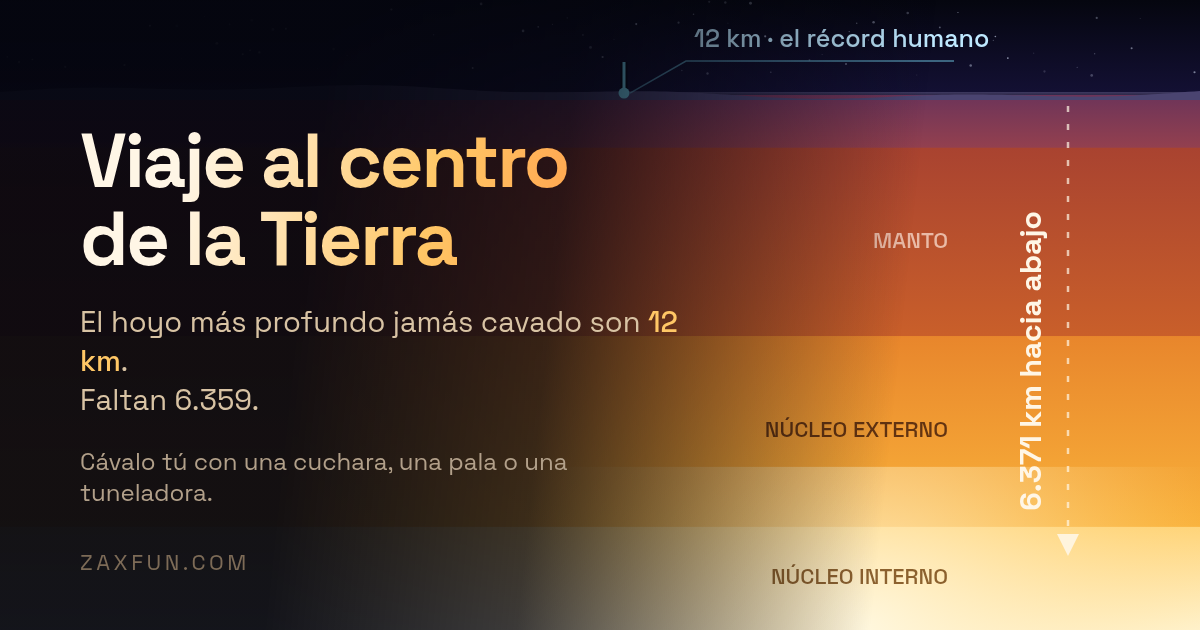
Agarra algo con qué cavar y ponte. La Tierra mide 12.742 km de lado a lado.
¿Con qué cavas?
¿Hasta dónde quieres llegar?
¿Cuál es el hoyo más profundo del mundo?
El pozo superprofundo de Kola, en Rusia: 12.262 metros. Se empezó en 1970 y se paró en 1992, después de 22 años de taladro. No lo detuvo el dinero: lo detuvo el calor. A 180 °C la roca dejaba de romperse y se cerraba sola sobre la broca. Y con todo eso, esos 12 km son el 0,19 % del camino al centro de la Tierra.
Esta es la tabla de cuánto se tarda en llegar a cada profundidad con cada herramienta, calculada con velocidades reales de excavación. Arriba puedes cavar el hoyo tú mismo y ver capa por capa lo que hay debajo.
| Hasta dónde | Profundidad | Con una cuchara | Con pico y pala | Con una tuneladora | Con un taladro petrolero |
|---|---|---|---|---|---|
| Donde vive la lombriz | 30 cm | 10 h | 26 min | 4 min | 1 min |
| Los cimientos de una casa | 3 m | 4 días | 4 h | 36 min | 15 min |
| El metro más hondo (Arsenalna, Kiev) | 105,5 m | 147 días | 6 días | 21 h | 9 h |
| La cueva más profunda (Veryovkina) | 2.212 m | 8 años | 132 días | 18 días | 8 días |
| La mina más profunda (Mponeng) | 4.000 m | 15 años | 238 días | 33 días | 14 días |
| El hoyo más hondo jamás hecho (Kola) | 12.262 m | 47 años | 2 años | 102 días | 43 días |
| Donde se acaba la corteza (Moho) | 35 km | 133 años | 6 años | 292 días | 122 días |
| El fondo del manto | 2.890 km | 10.989 años | 471 años | 66 años | 27 años |
| El centro de la Tierra | 6.371 km | 24.226 años | 1.038 años | 145 años | 61 años |
| Salir por el otro lado | 12.742 km | 48.452 años | 2.077 años | 291 años | 121 años |
Velocidades usadas: cuchara 3 cm/h · pico y pala 70 cm/h (0,7 m³ de tierra blanda por hora, en un hoyo de 1 m² de sección) · tuneladora 5 m/h (el récord mundial de avance diario, 124,4 m en el Jilin Water Project, China, 2021) · taladro petrolero 12 m/h en formación blanda. Ojo al detalle: el Kola promedió 0,06 m/h en 22 años, porque lo lento no es taladrar sino sacar la tubería, cambiar la broca y volver a bajar 12 km.
Preguntas frecuentes
¿Cuánto se tarda en cavar hasta el centro de la Tierra?
Con pico y pala, 1.038 años sin parar ni un día. Con una cuchara, 24.226 años. Con una tuneladora al ritmo del récord mundial, 145 años, y con un taladro petrolero 61. El centro está a 6.371 km.
¿Qué pasaría si cavaras un túnel hasta el otro lado de la Tierra?
Si el túnel estuviera vacío y te tiraras dentro, saldrías por el otro lado del planeta en 42 minutos, pasando por el centro a 8 km por segundo. Está calculado y no depende de por dónde lo hagas. En la práctica no se puede: a partir de los 2.890 km ya no hay roca sino metal líquido a 4.000 °C.
¿A qué temperatura está el centro de la Tierra?
Unos 5.200 °C, casi lo mismo que la superficie del Sol. Aun así el núcleo interno es sólido: la presión no deja que el hierro se funda porque los átomos no tienen a dónde moverse.
¿Cuál es la mina más profunda del mundo?
La mina de oro de Mponeng, en Sudáfrica, a unos 4.000 metros. La roca está a 66 °C y bajan toneladas de hielo cada día para que se pueda trabajar.
¿Por qué no se puede cavar hasta el centro de la Tierra?
Por el calor y por la presión, no por la distancia. A 12 km ya hace 180 °C y la roca fluye como plastilina en vez de romperse. Más abajo, a 1.500 km, hay 600.000 atmósferas: cualquier hueco se cerraría en un segundo. Y desde los 2.890 km lo que hay es metal fundido.
¿Qué capas tiene la Tierra, y a qué profundidad empieza cada una?
La corteza llega a unos 35 km y es todo lo que hemos pisado. El manto va de ahí a 2.890 km: roca sólida que fluye y arrastra los continentes. El núcleo externo llega a 5.150 km y es hierro líquido girando — es lo que hace que funcione la brújula. El núcleo interno, hasta 6.371 km, es hierro sólido al rojo blanco.
What is the deepest hole in the world?
The Kola Superdeep Borehole, in Russia: 12,262 metres. They started in 1970 and stopped in 1992, after 22 years of drilling. It was not the money that stopped them, it was the heat. At 180 °C the rock stopped breaking and closed itself around the bit. And even so, those 12 km are 0.19 % of the way to the centre of the Earth.
Here is how long it takes to reach each depth with each tool, worked out from real digging speeds. Up above you can dig the hole yourself and see what is down there, layer by layer.
| How far | Depth | With a spoon | With a pick and shovel | With a boring machine | With an oil drill |
|---|---|---|---|---|---|
| Where the earthworm lives | 30 cm | 10 h | 26 min | 4 min | 1 min |
| The foundations of a house | 3 m | 4 days | 4 h | 36 min | 15 min |
| The deepest subway (Arsenalna, Kyiv) | 105.5 m | 147 days | 6 days | 21 h | 9 h |
| The deepest cave (Veryovkina) | 2,212 m | 8 years | 132 days | 18 days | 8 days |
| The deepest mine (Mponeng) | 4,000 m | 15 years | 238 days | 33 days | 14 days |
| The deepest hole ever dug (Kola) | 12,262 m | 47 years | 2 years | 102 days | 43 days |
| Where the crust ends (the Moho) | 35 km | 133 years | 6 years | 292 days | 122 days |
| The bottom of the mantle | 2,890 km | 10,989 years | 471 years | 66 years | 27 years |
| The centre of the Earth | 6,371 km | 24,226 years | 1,038 years | 145 years | 61 years |
| Out the other side | 12,742 km | 48,452 years | 2,077 years | 291 years | 121 years |
Speeds used: spoon 3 cm/h · pick and shovel 70 cm/h (0.7 m³ of soft earth per hour, in a hole with a 1 m² cross-section) · boring machine 5 m/h (the world daily advance record, 124.4 m at the Jilin Water Project, China, 2021) · oil drill 12 m/h in soft formation. Worth noting: Kola averaged 0.06 m/h over 22 years, because the slow part is not drilling but pulling the pipe, changing the bit and lowering 12 km of it back down.
Frequently asked questions
How long would it take to dig to the centre of the Earth?
With a pick and shovel, 1,038 years without stopping for a single day. With a spoon, 24,226 years. With a boring machine running at the world record pace, 145 years, and with an oil drill, 61. The centre is 6,371 km down.
What would happen if you dug a tunnel through the Earth?
If the tunnel were empty and you jumped in, you would come out the other side of the planet in 42 minutes, passing through the centre at 8 km a second. Somebody did the maths, and it does not depend on where you dig it. In practice you cannot: past 2,890 km there is no rock, only liquid metal at 4,000 °C.
How hot is the centre of the Earth?
About 5,200 °C, roughly the same as the surface of the Sun. The inner core is solid anyway: the pressure will not let the iron melt, because the atoms have nowhere to go.
What is the deepest mine in the world?
The Mponeng gold mine in South Africa, about 4,000 metres down. The rock sits at 66 °C and they send tonnes of ice down every day so people can work.
Why can't we dig to the centre of the Earth?
Because of heat and pressure, not distance. At 12 km it is already 180 °C and the rock flows like putty instead of breaking. Further down, at 1,500 km, there are 600,000 atmospheres: any hollow would close in a second. And from 2,890 km on, what is there is molten metal.
What are the Earth's layers, and how deep does each one start?
The crust reaches about 35 km and is everything we have ever walked on. The mantle runs from there to 2,890 km: solid rock that flows and drags the continents along. The outer core reaches 5,150 km and is spinning liquid iron — it is what makes the compass work. The inner core, down to 6,371 km, is solid iron at white heat.