




¿Cuánto falta?
La pregunta del asiento de atrás, aplicada al universo.
1¿A dónde vamos?
2¿Y cómo vamos?
Sin spoilers: el tiempo lo descubres por el camino.
¿Cuánto se tarda en llegar a la Luna en carro?
160 días, conduciendo a 100 km/h sin parar ni una vez: ni a dormir, ni a cargar gasolina, ni al baño. La Luna está a 384.400 km, así que un carro tardaría más de cinco meses en recorrer lo que a la luz le cuesta 1,3 segundos. Y la Luna es lo cerca que está algo ahí arriba.
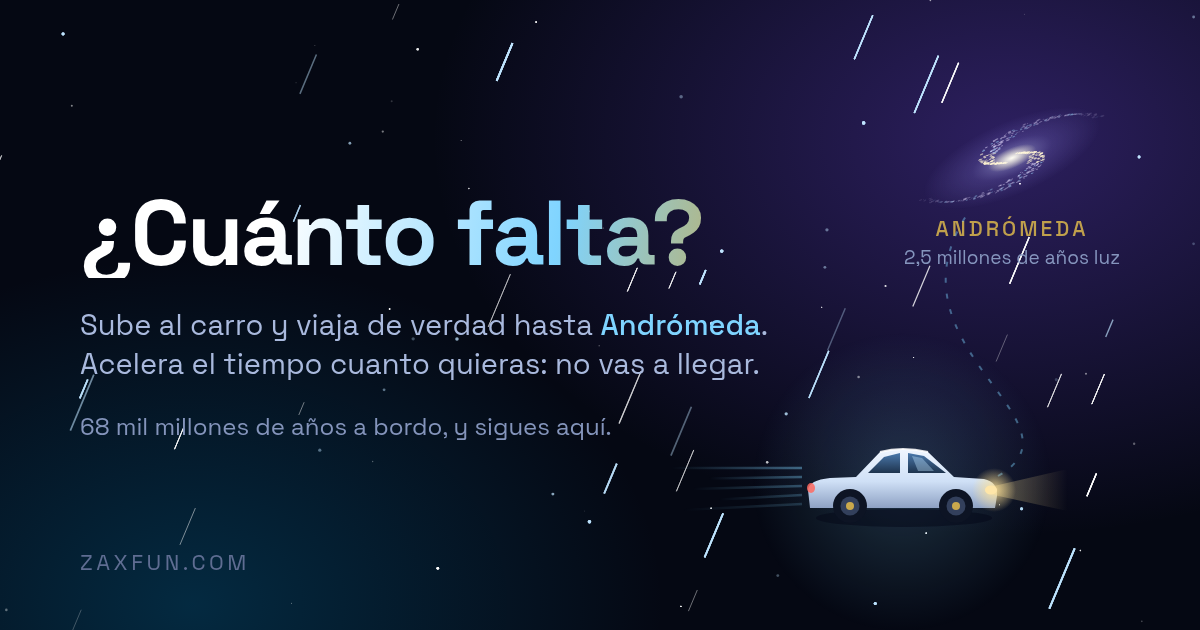
Esta es la tabla completa de tiempos de viaje por el sistema solar y más allá, calculada con distancias reales y velocidades reales. Arriba puedes hacer el viaje de verdad y ver cómo la barra de progreso no se mueve.
| Destino | 🚗 En carro | ✈️ En avión | 🚀 En cohete | 💫 A la velocidad de la luz |
|---|---|---|---|---|
| La Luna | 160 días | 18 días | 10 horas | 1,3 segundos |
| El Sol | 171 años | 19 años | 160 días | 8,3 minutos |
| Marte | 257 años | 29 años | 240 días | 12,5 minutos |
| Saturno | 1.454 años | 162 años | 4 años | 1,2 horas |
| Plutón | 6.559 años | 729 años | 17 años | 5,3 horas |
| La Voyager 1 | 28.519 años | 3.169 años | 73 años | 23,2 horas |
| Próxima Centauri | 46 millones de años | 5,1 millones de años | 117.514 años | 4,2 años |
| Andrómeda | 27 billones de años | 3,0 billones de años | 70 mil millones de años | 2,5 millones de años |
| El borde del universo | 502 mil billones de años | 56 mil billones de años | 1,3 mil billones de años | 46.500 millones de años |
Velocidades usadas: carro 100 km/h · avión 900 km/h · cohete 39.000 km/h (la del Apolo 10, el objeto tripulado más rápido de la historia) · luz 1.079.252.849 km/h. Las distancias a los planetas son la media orbital desde la Tierra.
Preguntas frecuentes
¿Cuánto se tarda en llegar a Marte?
En carro, 257 años. Una sonda real tarda entre 7 y 9 meses, porque no va en línea recta: se lanza cuando Marte y la Tierra están bien colocados y se deja caer por una curva que aprovecha la gravedad del Sol.
¿Cuánto se tarda en llegar al Sol?
19 años en avión y 171 años en carro. Los 149,6 millones de km que nos separan del Sol son la medida que los astrónomos usan como regla del sistema solar: una Unidad Astronómica.
¿Y a la estrella más cercana?
Próxima Centauri está a 4,25 años luz. En el cohete más rápido que hemos tripulado serían 117.514 años: saldrías hoy y llegaría una civilización que ya no se acordaría de por qué salió. Es el motivo real por el que no hemos ido.
¿Cuánto tardaría la luz en hacer estos viajes?
La luz va a 1.079 millones de km/h: 1,3 segundos a la Luna, 8 minutos al Sol, 5 horas a Plutón y 2,5 millones de años a Andrómeda. Nada puede ir más rápido, y aun así el universo le queda enorme. En el juego puedes viajar a la velocidad de la luz y comprobarlo.
¿Se puede llegar a Andrómeda?
No. Ni a la velocidad de la luz: son 2,5 millones de años luz, o sea 2,5 millones de años de viaje en el mejor de los casos. En carro serían 27 billones de años, unas 2.000 veces la edad del universo. La gracia del juego es precisamente esa: acelerar el tiempo hasta mil millones de años por segundo y ver que la barra sigue en el 0 %.
¿Los números son de verdad?
Sí. Distancias medias reales y velocidades reales, sin trampa. Lo único que se ignora es la parte incómoda: que no hay carretera, que no se puede respirar y que el tiempo asume que no paras ni un segundo.
How long does it take to drive to the Moon?
160 days at 100 km/h without stopping once — no sleep, no gas, no bathroom breaks. The Moon is 384,400 km away, so a car needs more than five months to cover what light crosses in 1.3 seconds. And the Moon is the close one.
Here is the full table of travel times across the solar system and beyond, using real distances and real speeds. Up above you can actually take the trip and watch the progress bar refuse to move.
| Destination | 🚗 By car | ✈️ By plane | 🚀 By rocket | 💫 At light speed |
|---|---|---|---|---|
| The Moon | 160 days | 18 days | 10 hours | 1.3 seconds |
| The Sun | 171 years | 19 years | 160 days | 8.3 minutes |
| Mars | 257 years | 29 years | 240 days | 12.5 minutes |
| Saturn | 1,454 years | 162 years | 4 years | 1.2 hours |
| Pluto | 6,559 years | 729 years | 17 years | 5.3 hours |
| Voyager 1 | 28,519 years | 3,169 years | 73 years | 23.2 hours |
| Proxima Centauri | 46 million years | 5.1 million years | 117,514 years | 4.2 years |
| Andromeda | 27 trillion years | 3.0 trillion years | 70 billion years | 2.5 million years |
| The edge of the universe | 502 quadrillion years | 56 quadrillion years | 1.3 quadrillion years | 46.5 billion years |
Speeds used: car 100 km/h · plane 900 km/h · rocket 39,000 km/h (Apollo 10, the fastest crewed object ever) · light 1,079,252,849 km/h. Planet distances are the average orbital distance from Earth.
Frequently asked questions
How long does it take to get to Mars?
By car, 257 years. A real probe takes 7 to 9 months, because it doesn't fly straight: it launches when Mars and Earth line up and then coasts along a curve that borrows the Sun's gravity.
How long would it take to reach the Sun?
19 years by plane, 171 years by car. The 149.6 million km between us and the Sun is the ruler astronomers measure the solar system with: one Astronomical Unit.
What about the nearest star?
Proxima Centauri is 4.25 light years away. In the fastest crewed rocket we have ever built that's 117,514 years — you'd leave today and a civilization that no longer remembers why would arrive. That's the real reason we haven't gone.
How long does light take to make these trips?
Light travels at 1.079 billion km/h: 1.3 seconds to the Moon, 8 minutes to the Sun, 5 hours to Pluto and 2.5 million years to Andromeda. Nothing can go faster, and the universe still dwarfs it. In the game you can travel at light speed and see for yourself.
Can you ever reach Andromeda?
No. Not even at light speed: 2.5 million light years means 2.5 million years of travel at best. By car it's 27 trillion years — about 2,000 times the age of the universe. That's the whole joke of the game: speed time up to a billion years per second and watch the bar sit at 0%.
Are the numbers real?
Yes. Real average distances and real speeds, no cheating. The only thing ignored is the inconvenient part: there's no road, you can't breathe, and the clock assumes you never stop for a second.
- Llevas a bordo
- —
- Has recorrido
- —
- Todavía faltan
- —
Mientras tanto…
Acelerar el tiempo
¡Llegaste!